

Now that we’ve walked through how to set up an Irrevocable Life Insurance Trust (ILIT), let’s walk through some common and extremely costly mistakes people make with their ILITs. These errors can cost you and your family millions. They can bring legal liability and IRS issues into your lives. And they can lead to your trust shutting down.
As you know, ILITs are powerful estate-planning tools, but they’re also easy to mismanage. Which you’ll soon learn can be costly in many ways. Because an ILIT is irrevocable and governed by strict tax rules, even small mistakes can cause the policy to be pulled back into the taxable estate, defeat creditor protection, or invalidate the trust’s funding.
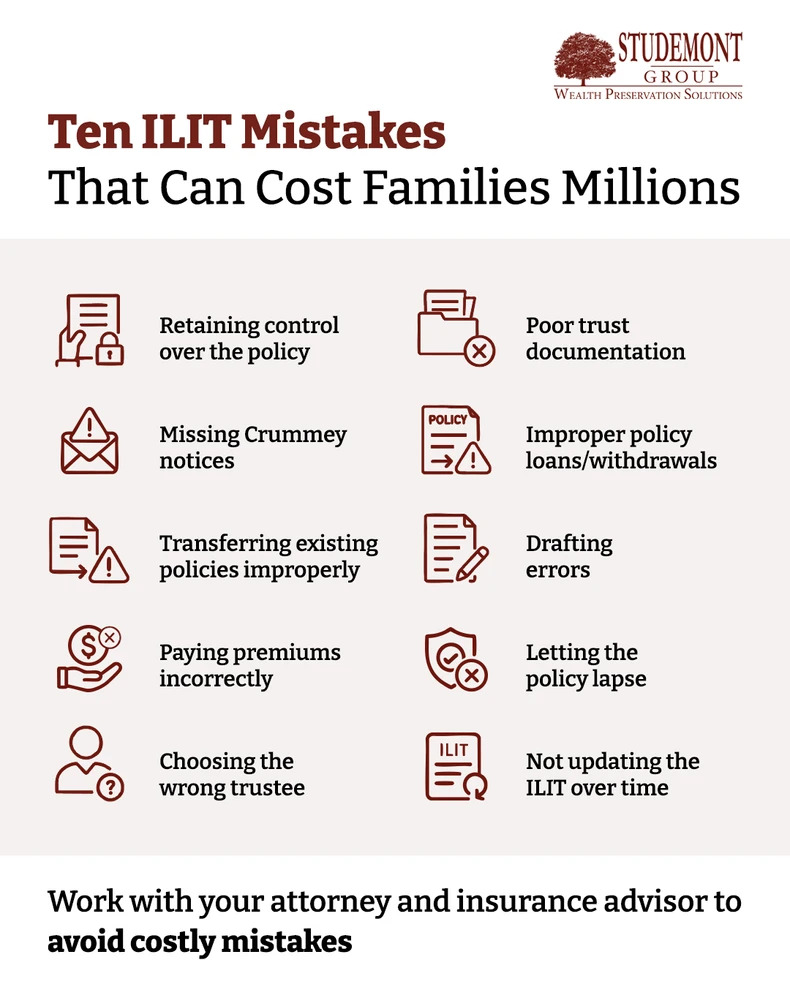
Let’s explore the most common mistakes made with ILITs, mistakes that can ruin both tax benefits and your entire plan:
1. Retaining “Incidents of Ownership” Over the Policy
As you learned when we went over when setting up your ILIT, a Trustee, not you, must run your ILIT for it to be legally compliant. You are not allowed to share in these duties.
Why it’s costly: If the IRS concludes the insured had any control over the policy, the death benefit is included in the taxable estate, defeating the main purpose of the ILIT.
You absolutely cannot:
- Pay premiums personally (even once)
- Change beneficiaries
- Borrow against the policy
- Serve as trustee (in some situations)
2. Improper or Missing Crummey Notices
Crummey notices, as you remember, must be sent to beneficiaries every time a contribution is made, giving them the right to withdraw funds. A single lapse in the policy can spell trouble.
Why it’s costly: Without proper notices (and proof), the IRS can disallow the annual exclusion gifts, causing:
- Gift tax liability, and/or
- Estate inclusion of the policy
Failing to send Crummey notices is one of the most common and expensive ILIT failures.
3. Funding the Trust With an Existing Policy Without Planning Around the 3-Year Rule
If you transfer an existing policy to an ILIT and die within three years, the full death benefit is pulled back into the estate.
For high-value policies, this can create a multi-million-dollar tax bill that families are forced to pay in cash. For many families, that means the death benefit could face estate taxes at rates approaching 40%, creating an unnecessary and avoidable hit to the legacy they intended to protect.
A more secure approach is to have the ILIT acquire a new policy from the start. This sidesteps the 3-year lookback rule and keeps the death benefit outside the taxableestate. Be sure to coordinate with your estate planning attorney before adjusting or replacing any existing coverage.
4. Paying Premiums Improperly
As noted in the “Incidents of Ownership” section, all premiums must be paid by the ILIT, not personally by the insured.
Common mistakes in making improper payments include:
- Direct premium payments by the insured
- “Loans” to the trust without proper documentation
- Late contributions that make Crummey notices ineffective
These mistakes can create conflicts of ownership, estate inclusion, or gift-tax issues.
5. Choosing An Unsuitable Trustee
Who you choose as the Trustee is a very, very serious decision to make. Using the insured or spouse as trustee can be fatal to the trust.
The biggest risk:
The IRS may argue the insured retains control over the policy, which would cause estate inclusion.
Choose wisely instead from sources such as:
- Independent trustees
- Professional trustees
- Trusted non-beneficiaries
6. Failing to Maintain Proper Trust Formalities
Quite simply, ILITs require ongoing compliance. Everyone must be onboard to perform their legal duties to keep the trust compliant.
The most common formality failures made include:
- No separate trust bank account
- No documentation of contributions and withdrawals
- No trustee meeting minutes
- Failure to keep records of notices
Having a lack of paperwork is a major issue in audits. Your Trustee must ensure your trust’s records are always maintained and up-to-date.
7. Improper Loans or Withdrawals From Cash-Value Policies
Moving money around in an ILIT must be done transparently and legally. If the Trustee borrows from or withdraws cash from the policy without clear documentation, it may:
- Cause the policy to lapse
- Trigger income tax
- Create incidents of ownership
8. Drafting Errors in the Trust Agreement
Drafting an ILIT must be done with an experienced Estate Planning Attorney. Without it, error-riddled ILITs are much more likely, which can lead to:
- Beneficiary disputes
- Inclusion of the death benefit in the taxable estate
- Disqualifying the trust for GST tax planning
The most common drafting mistakes are:
- Giving the insured too much control
- Failing to include a Crummey withdrawal provision
- Incorrect trustee powers
Again, be sure to have an Estate Planning Attorney draft your ILIT after aligning with you on your ILIT goals.
9. Letting the Policy Lapse
ILITs rely on annual gifts to stay current. Missing premium payments can cause a:
- Policy lapse
- Loss of protection
- Wasted gift-tax planning
For these reasons, it’s extremely important to ensure your policy funding remains consistent.
10. Not Updating the ILIT as Laws or Circumstances Change
Yes, your trust is irrevocable. With that said, change is the only constant, and as such, administration can (and often must) adapt to new laws and circumstances.
The most common of these are:
- Outdated trustees
- Beneficiary changes after divorces/remarriages
- No adjustments for new tax laws
Be sure, once again, to work with your Estate Planning Attorney. Decanting or trust modification (where allowed) can sometimes fix many issues, but your attorney will be able to best guide you through them.
Summary: Don’t Make the Most Expensive ILIT Mistakes
Now that you’ve read about these common errors, you are much better equipped to move forward with proper stewardship of your ILIT. As a quick reminder in summary, the ten most costly errors are:
1. Incidents of ownership (the biggest estate-tax disaster).
2. Missing or improper Crummey notices (most common administrative failure).
3. Transferring an existing policy without planning around the 3-year rule.
4. Paying premiums incorrectly.
5. Using the insured or a spouse as a trustee.
6. Poor documentation and trust formalities.
7. Policy loan/withdrawal errors.
8. Drafting mistakes as you draft the trust.
9. Policy lapse due to poor oversight.
10. Failure to update the plan over time as changes surrounding it occur.
Please note that Studemont Group, LP is not a legal firm and does not offer legal advice. We advise you to consult with your attorney, and we will coordinate with your counsel in creating and executing your ILIT strategy.

John McDonough is the founder and President & CEO of Studemont Group, the Houston-based wealth preservation advisory firm he founded in 2010. With more than 25 years in the industry and Texas General Lines licensure held since 2001, he focuses on the advanced planning that complex estates demand — premium financing, irrevocable life insurance trusts (ILITs), estate tax liquidity, and business succession — coordinated into a single strategy rather than sold as separate products. A dedicated educator through the JMac Wealth channel, he works alongside clients’ attorneys and CPAs to help families and business owners protect, preserve, and transfer wealth across generations.
Related Posts